
Trucking Industry In U.S.

I want to start my writing with statistics about trucking sector;
- Trucking employs 8.4 million people. Contributes a larger share to the country’s gross domestic product (GDP) than any other freight mode.Also The Freight Transportation Services Index (TSI) shows that trucking is expanding faster than other transportation methods.
- 13.9 million registered single-unit and combination trucks.
- 3.53 million truck drivers in the US in 2022.
- In 2022, the Bureau of Transportation Statistics estimated that there were 271,720 commercial vehicle mechanics and diesel engine specialists, 206,370 dispatchers, and 848,240 shipping, receiving, and traffic clerks in the US
The average age of commercial truck drivers in the US stands at 55 years. Workers aged 45-64 in truck transportation make up almost 50% of the workforce as of January 2024, signaling an aging workforce requiring replenishment. As per reports young population has not so much intention to work in trucking industry. This is the biggest problem in front of the sector.
According to Statista, the industry has faced a persistent shortage that is expected to grow to 162,000 drivers by 2030.
The industry faces an estimated driver shortage between 60,000 and 80,000 positions in 2025.
In connection with this issue ; 56 percent of business who chose “staffing retention” as a priority plan to improve salaries and work-life balances to this end, with an additional 43 percent putting more emphasis on recruitment efforts and 44 percent providing better training and development opportunities.
consistently high labor turnover rates create the same challenge as a shortage—companies are unable to operate at full capacity and fill shipper demands in a timely fashion,”(James Peoples Jr., professor of economics at the University of Wisconsin)
Driver Wages: Driver compensation represents 34% of total freight trucking costs. Entry-level drivers earn between $50,000 and $65,000, with median pay for heavy and tractor-trailer drivers exceeding $55,000 annually in 2025.
About Market
Market Revenue: In 2024, the US trucking industry generated $906 billion in revenue, down from $1.004 trillion in 2023 due to freight recession pressures. The industry grossed $940.8 billion in 2022, representing 80.7% of the nation’s total freight bill.
Annual Freight Volume: Trucks moved 11.27 billion tons of freight in 2024, accounting for approximately 72% of all domestic freight by weight.
Trucking’s revenues will grow from $1.01 trillion in 2023 to $1.51 trillion in 2034, which will account for 78.8% of the freight market.
The top 10 companies control only 12% of market share
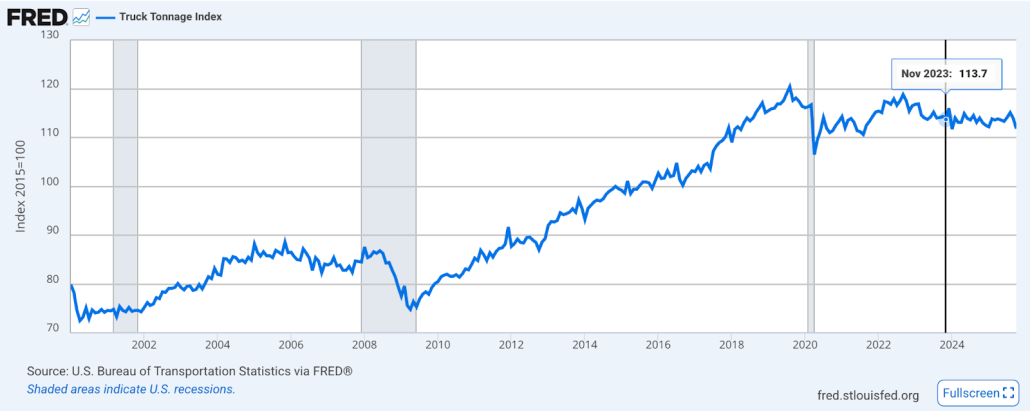
Data from the Department of Transportation shows that freight volumes have been on a noticeable downtrend since early 2022
Operating Ratio: The average industry operating ratio stands at 90%, meaning carriers keep only 10% of revenue as operating profit. This thin margin has a standard deviation of 10-20%, making trucking profitability more volatile than most industries.
2
Weekly Operational Loss: A shortage of approximately 24,000 truck drivers leaves equipment idle, costing the freight industry an estimated $95.5 million every week in lost revenue at $3,971 per truck per week.
After these informations we have some knowledge about stats now we will look at United States important Export-Import numbers:
In the last two years, truck container crossings has increased at a much higher rate than rail containers.
United States’ biggest land trade partners are Mexico and Canada lets look them
Excluding shipments from Mexico, there hasn’t been a significant increase in cargo values and weights.
Conclusions
The U.S. trucking industry’s recent journey through a ‘freight recession’ and thin 10% operating margins underscores its inherent volatility. Yet, the long-term outlook remains bullish. The significant rise in truck container crossings from Mexico and Canada indicates that land-based trade is becoming more vital than ever. As the industry moves toward a $1.5 trillion market share by 2034, the winners will be those who can manage operational costs—particularly driver compensation and fuel—while maintaining the agility to handle fluctuating freight volumes. Trucking isn’t just growing; it is evolving to meet the demands of a more integrated North American supply chain.
Resources:
ATA Freight Transportation Forecast 2023 to 2034
https://rxo.com/resources/research/us-truckload-market-guide/
https://www.actresearch.net/resources/blog/trucking-industry-forecast-2025
https://drivewyze.com/resources/guides/trucking-101-introductory-guide/
https://www.datatruck.io/blog/20%2B-us-trucking-market-statistics-to-know
https://www.newsweek.com/us-trucking-industry-deep-trouble-10861497
https://www.newsweek.com/america-trucking-shortage-logistics-supply-chain-2097123
https://www.datatruck.io/blog/20%2B-us-trucking-market-statistics-to-know
Leave a Reply
Want to join the discussion?Feel free to contribute!